The New Global Workplace Standard: One Team, One Standard, Everywhere
- Articles
- 24 Sep 2026

Delivering one successful workplace is a project. Delivering successful workplaces across multiple countries is an operating model.
That distinction matters.
A workplace concept may perform brilliantly in London, but replicating it in Munich, Paris, Zurich, New York, or Barcelona introduces different regulations, supply chains, construction methods, commercial conditions, and cultural expectations.
This is where many global workplace programs begin to unravel.
Organizations assume that scaling means taking a successful design, reproducing the drawings, and issuing the same specification in every market. But global consistency does not come from copying and pasting an office. It comes from establishing a clear framework for how decisions are made, standards are applied, risks are controlled, and local requirements are managed.
The objective is not to make every workplace identical.
It is to ensure that every workplace delivers a consistent experience, level of quality, and operational outcome.
The Myth of the Global Rollout
The phrase “global rollout” makes international workplace delivery sound deceptively simple.
Create the standard. Issue the drawings. Replicate the model.
In practice, every market introduces variables that affect how the workplace can be designed, procured, constructed, and operated. Products specified centrally may be unavailable locally. Regulatory requirements may necessitate redesign. Construction methodologies may differ. A solution that supports employees in one location may not reflect how teams work in another.
A manufacturer, for example, might specify the same workstation, acoustic product, lighting system, or finish across its entire portfolio. In one market, that product may be readily available. In another, it could carry a lengthy lead time, significant import cost, or a certification that does not meet local requirements.
The answer is not to abandon the global standard. It is to define what the standard is intended to achieve, then identify appropriate local solutions that protect that intent.
The strongest global workplace standards therefore begin with principles:
- What should the employee experience feel like?
- Which aspects of the brand must remain consistent?
- What are the non-negotiable quality and performance requirements?
- Which workplace settings must be available?
- What technical and operational standards must be maintained?
- Where can local teams adapt the solution?
- Who has the authority to approve an exception?
These questions create a scalable system. A collection of drawings does not.
Global Workplace Strategy Is Really About Governance
As a workplace portfolio grows, complexity grows with it.
More locations bring more stakeholders, suppliers, consultants, approval routes, and opportunities for standards to drift. Without a clear governance structure, decisions are repeated, responsibilities become blurred, and local exceptions gradually become the norm.
Before an international workplace program begins, organizations need clear answers to four fundamental questions.
Who decides?
Who owns the global workplace standard? Who approves local deviations? Who controls the budget? Who signs off the design? Who manages the landlord interface? Who owns the employee experience? Who makes the final decision when global requirements conflict with local constraints?
How are decisions recorded?
If approvals, exceptions, and lessons learned are not documented centrally, the same issues will be reconsidered in every market. This creates delay and makes it difficult to maintain accountability.
How is performance reported?
Leadership should be able to understand the status of a global portfolio without interpreting a different reporting format for every location. Cost, schedule, risk, change, quality, and decision status should be visible and comparable.
How are competing priorities resolved?
Real estate, HR, IT, facilities, finance, leadership, and local business teams all have legitimate priorities. Governance provides a structured way to resolve those priorities before they become late-stage project problems.
One Team and One Standard Does Not Mean One Design
Consistency is often confused with uniformity.
A global financial institution may have offices in Geneva, Madrid, and New York that look very different. The architecture, materials, planning, and local identity may vary, but employees should still recognize the organization’s workplace philosophy.
They should understand how to use the space. Technology should work in a familiar way. Quality should feel consistent. The approach to hospitality, accessibility, collaboration, and focused work should be recognizable.
Employees should not have to relearn the workplace every time they visit another office.
A scalable global framework should establish common expectations across:
- Workplace strategy and employee experience
- Brand and design principles
- Space types and performance requirements
- Technology and operational standards
- Sustainability objectives
- Governance and approval routes
- Commercial controls
- Reporting
- Delivery methodology
Within that framework, individual workplaces can respond to their architecture, location, workforce, and culture.
The question is not: Does every office look the same?
The better question is: Does every office deliver the same standard of experience and performance?
The Standard Must Leave Room for Local Reality
Global standards are only effective when they can be implemented.
Every market introduces local conditions that influence the outcome.
Building codes, accessibility requirements, fire regulations, environmental standards, and permitting processes vary between regions. Supply chains affect availability, pricing, warranties, lead times, and maintenance. Contractor capabilities and procurement practices are not consistent across countries. Workplace behaviors, management structures, meeting culture, and employee expectations also differ.
A successful workplace program protects the global objective while responding intelligently to these conditions.
Imagine that a global standard specifies a particular acoustic partition system. In one country, the system is readily available and supported by an established installer network. In another, importing it would compromise both the program and budget.
The correct response is not necessarily to insist on the original product. The local team should identify an alternative that meets the same acoustic, fire, visual, and durability requirements. The product may change, but the required outcome does not.
That is the difference between a prescription and a performance standard.
Combining Central Control with Local Expertise
Organizations are often presented with a false choice between central control and local autonomy.
Global programs need both.
The central team should retain ownership of the strategic objectives, workplace principles, budget framework, governance process, reporting requirements, and non-negotiable performance standards.
Local specialists should provide regulatory knowledge, supply-chain intelligence, technical coordination, construction oversight, market-specific cost information, and stakeholder engagement.
Neither side can deliver the strongest outcome alone.
Central control without local expertise can produce standards that are difficult, expensive, or impossible to implement. Local autonomy without central governance can result in fragmented workplaces, inconsistent quality, duplicated effort, and limited portfolio visibility.
The operating model must connect the two.
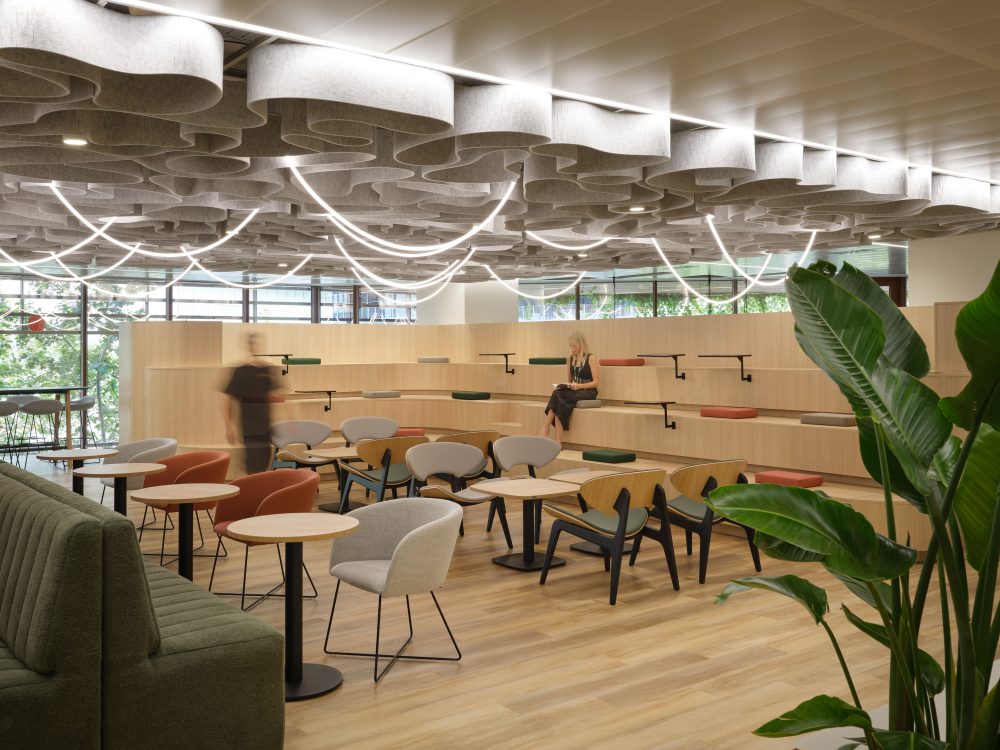
A practical example of this balance can be seen in Zenixspace’s Barcelona project for a confidential life sciences client. The workplace aligned global standards with local identity while providing clearly defined environments for focus, collaboration, social interaction, and support. The project combined strategy, project management, furniture, design, and construction within a coordinated delivery approach.
The result was not a generic global office transplanted into Barcelona. It was a locally relevant workplace operating within a wider global framework.
Reporting Is the Control System
Reporting is one of the least visible parts of a workplace program, but it is often where control is either established or lost.
If every location reports cost, schedule, risk, change, and quality differently, leadership cannot compare performance or intervene early. Decisions become reactive because information is fragmented, inconsistent, or out of date.
A global reporting framework should establish:
- A consistent definition of project stages
- Standard cost and schedule reporting
- A common risk and change-control process
- Clear ownership of actions and decisions
- Agreed quality and performance measures
- Portfolio-level visibility across every location
This does not mean every project requires the same level of reporting. A small refurbishment and a major headquarters will require different levels of detail.
The underlying structure, however, should remain consistent.
Consistency of reporting creates consistency of control. Consistency of control supports better decisions.
Workplace Standards Must Reflect How People Actually Work
A global standard cannot remain static while workforce behavior changes.
The Gensler Global Workplace Survey 2026 found that workplace performance gaps continue to affect how employees use their environments, with many workers adapting spaces themselves to compensate for issues involving ergonomics, privacy, noise, and room availability. The research also shows that work patterns vary by country, industry, age, and role.
This reinforces an important point: global standards must be consistent enough to protect quality, but flexible enough to respond to different users and evolving ways of working.
The most effective standards are therefore reviewed against evidence. Utilization data, employee feedback, operational performance, post-occupancy findings, and lessons learned should inform each new project.
A global workplace standard should not be treated as a finished document. It should operate as a controlled, evolving system.
Zenixspace explores this further in Future-proofing your global workplace portfolio, which considers how adaptable planning, data-led decisions, and integrated strategy can help workplace portfolios respond to changing business and workforce requirements.
The New Global Workplace Standard
The organizations leading the next generation of workplace transformation will not necessarily be those with the most detailed design manuals.
They will be the organizations that can consistently turn strategy into high-quality workplaces across different markets.
That requires:
- Clear principles rather than rigid prescriptions
- Central governance supported by local expertise
- Defined responsibilities and approval routes
- Comparable reporting across the portfolio
- Progressive commercial and technical control
- A repeatable delivery methodology
- Continuous learning from completed workplaces
This is why global occupiers increasingly need more than a collection of disconnected consultants and contractors. They need an accountable delivery framework that connects strategy, design, commercial control, technical coordination, and construction.
Zenixspace’s integrated capabilities are structured around this challenge: maintaining consistency across international markets while adapting intelligently to local requirements. Our model aligns workplace strategy, design, project management, construction, and furniture under a single framework, helping organizations maintain clarity and control from the initial brief through delivery and occupation.
The real measure of a global workplace strategy is not whether every office looks identical.
It is whether every location delivers the same level of experience, performance, quality, and control.
One workplace can succeed through strong project delivery.
A global workplace program succeeds through a strong operating model.
One team. One standard. Everywhere.